ENTRY / 007/ LOG 2026.09/ TYPE DIVING
Malaysian Diver Missing at Pulau Weh: What Divers Can Learn About Strong Currents
A respectful look at the September 2026 Sabang search operation, followed by practical, general guidance for planning and diving safely in strong current.
- PUBLISHED27 SEPTEMBER 2026
- TYPEDIVING
- READ9 MIN
A difficult story, and a careful lesson
On 11 September 2026, Malaysian diver Ho Wee Han, 49, was reported missing during a dive around Shark Plateau and Pulau Seulako near Iboih, Sabang. BASARNAS Banda Aceh later closed the search operation after seven days. The final day included surface and underwater searches around the last known position, but the official notice did not report that he had been found.
This is first a story about a person and a family. It is not a reason to turn a missing-diver case into a lesson about fault. No public report I found establishes why the separation happened, so I will not pretend it does.
What caught my attention as a diver is the setting. Pulau Weh is beautiful, but current is part of what makes many sites there demanding. The safety discussion below is general diving information. It is not a claim about the cause of this disappearance.
What is confirmed
BASARNAS says the search concerned a Malaysian visitor reported missing in the Shark Plateau/Pulau Slako area of Sabang. Its 17 September notice describes a final-day search using rescue boats and divers, including a 12-nautical-mile surface sweep towards Batu Rondo before worsening weather temporarily stopped part of the operation. Local reporting consistently places the initial report on 11 September near Iboih and Pulau Seulako.
Details such as exact dive depth, group size and current conditions have appeared differently across news reports. Because those details are not all repeated in the final official SAR notice, I am treating them cautiously here. The one thing worth being clear about is that a search operation is not an investigation report. It should not be used to assign blame.
Why current deserves respect
Current is moving water. That sounds obvious on paper. Underwater, it is not.
It can be gentle at the surface and stronger at depth. It can run differently near the reef than it does in midwater. Tidal movement can also change direction during a dive. DAN notes that divers may see changes in both current speed and direction through the water column, which is one reason a detailed local briefing matters so much.
A drift dive is not automatically a dangerous dive. In the right conditions, going with the flow can be calm and enjoyable. The problem begins when a diver has to work against a current they were not prepared for, loses the group, or reaches the surface away from the expected pickup area.
Swimming hard against moving water increases workload. More workload means faster breathing and faster gas use. It can also make buoyancy, communication and simple decisions harder at exactly the wrong moment.
Before the dive: the questions I would ask
For a strong-current destination, I would want a briefing that answers practical questions rather than just naming the site.
- What is the current doing now, and what can it do as the tide changes?
- Is this a drift dive, an anchored descent, or a site where the plan can change after a surface check?
- How will entry, ascent and pickup work?
- What is the planned maximum depth and time?
- What is the lost-buddy and lost-diver procedure for this boat and this site?
- Who is carrying an SMB or DSMB, and does every diver know how to use their own?
- What condition would make the guide cancel the dive?
The answer to the last question says a lot. A good operator should be willing to call a dive when the conditions or diver experience do not line up. I would rather miss a famous site than turn a holiday dive into a bad decision.
Choosing an operator for current diving
This is not about judging any operator connected with this incident. It is a general checklist I would use anywhere current is part of the attraction.
I look for local knowledge, guides who ask honest questions about experience, sensible group sizes, clear boat support and a briefing that includes recovery and separation procedures. Oxygen, communications, signaling expectations and a clear pickup plan should never feel like awkward questions from a customer.
I also pay attention to whether the team is comfortable saying no. An operator that treats every booking as a guaranteed dive is not giving me confidence. Conditions, fatigue, equipment issues and comfort level all matter.
Know your own limit
A certification card is not the same thing as current experience. Someone may be qualified to dive, yet still be rusty, tired, underprepared for a particular site or overloaded with a camera, new equipment and unfamiliar conditions.
For me, this is where the real lesson is. Strong current leaves less spare attention. You need enough capacity to control buoyancy, monitor depth and gas, stay close to a buddy, understand the plan and react calmly if it changes.
There is nothing embarrassing about saying, “I do not want to do this dive today.” That is not backing out. It is making a good call before the water makes it for you.
Buddy and group discipline
On a current dive, it is easy to focus so much on following the guide that you stop checking your buddy. That is a mistake. Stay close enough to notice a problem and respond, while still keeping the guide and the group in view.
If separation happens, follow the procedure agreed in the briefing and taught in your training. Do not turn a short separation into a second problem by chasing people through changing current. The exact action can differ by operator and conditions, which is why the pre-dive agreement matters.
If you and your buddy are together but separated from the group, staying together is usually more useful than each person trying to solve the problem alone.
SMB, DSMB and signaling
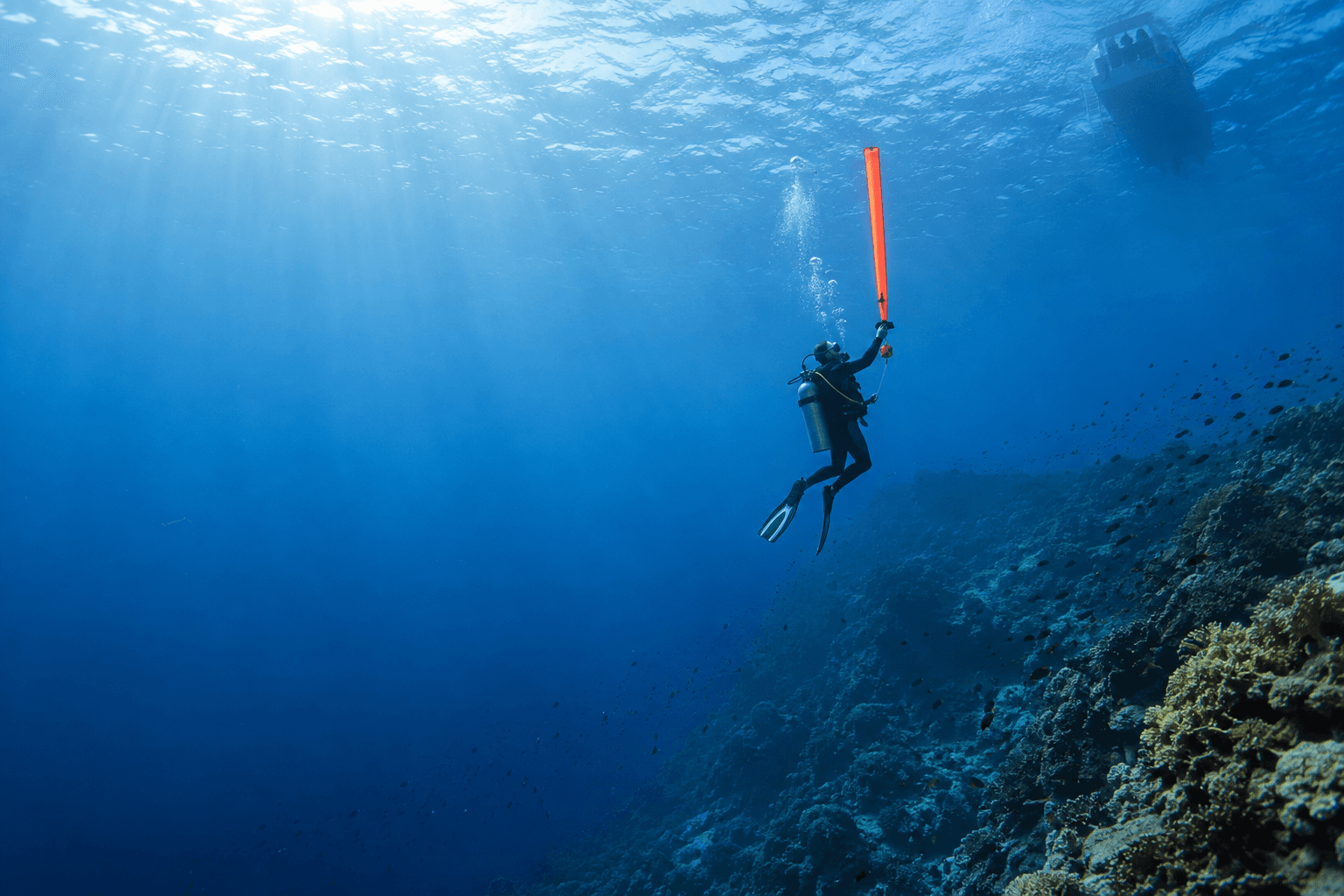
An SMB is a surface marker buoy. A DSMB is deployed from underwater and rises to the surface on a line. They are not magic, and carrying one without training is not enough. But in a drift or current situation, a visible marker can make a meaningful difference to a boat crew trying to track or find divers.
DAN recommends visual and audible signaling for drift diving. A whistle and signaling mirror are small, practical additions. Some divers also choose a personal locator, GPS or VHF device where it is appropriate and legal to use. None of these guarantee a rescue. They improve the chance that someone can see or locate you after a separation.
I would not rely only on the guide carrying a marker. Every diver should think about what they can carry, deploy and use competently.
What the dive computer can and cannot do
A dive computer is valuable because it helps a diver track depth, elapsed time, ascent rate, no-decompression information and safety-stop prompts. Some models add optional compass or air-integration functions.
But a computer does not tell you whether a current is safe. It does not replace a local briefing, gas management, buddy awareness, training or judgment. If the situation is becoming physically demanding, the useful response is not to stare at the screen longer. It is to recognise the problem early and follow the plan.
Gas management changes in moving water
Fighting current can change a calm dive into a high-workload dive very quickly. That is why I would check my SPG or air-integrated computer more often than usual, communicate gas status clearly and be willing to turn the dive earlier.
There is no universal pressure number that fits every dive. Reserve planning depends on the site, cylinder, depth, team and training. DAN discusses the rule of thirds as one possible planning approach for certain current dives, not as a universal rule. The practical point is simpler: do not use your normal calm-water gas consumption as an assumption when the current is doing extra work on your body.
If the current becomes more than expected
Panic burns energy and gas. The better starting point is to slow down, communicate and work with the plan you were briefed on.
Avoid exhausting yourself by swimming against a strong flow unless that is genuinely the agreed and feasible option. Use shelter from current only where it is safe and environmentally appropriate. Keep an eye on depth, buoyancy and gas. If an ascent is required, make it controlled, deploy a DSMB only if trained and appropriate, and follow the boat’s pickup procedure at the surface.
DAN also advises divers not to fight a current when they are down-current of a boat and cannot safely make progress against it. Positive buoyancy, signaling and staying with a buddy where possible are more useful than turning the situation into a sprint.
When to cancel
Anyone can call a dive at any time.
I would cancel or sit out a dive if the current is beyond my training or recent experience, the briefing leaves gaps, the recovery plan is unclear, I have an equipment problem, I am fatigued, my gas is not right, or I simply feel overloaded before entry. Anxiety does not always disappear underwater. It can become task loading.
The ocean will still be there. The dive site will still be there. Getting back on the boat with a clear head is the result that matters.
What I take away from this
Stories like this hit differently when you dive yourself. The takeaway is not that divers should fear current, or that a checklist can explain a disappearance. It is that current diving asks for planning, communication, surface support, appropriate equipment and an honest read of our own limits.
The people involved in this case deserve respect. For the rest of us, the useful response is to learn without pretending we know more than the facts allow.
> This article is general diving-safety information and is not a substitute for proper training, local dive briefings or professional instruction.